


SERVICE DESCRIPTION | ROTARY EVAPORATOR Service Description A rotary evaporator is a laboratory instrument used to remove or evaporate solvents from a solution in a controlled manner through a combination of heating, vacuum pressure, and flask rotation. The process enables…
- iLaB (Integrated Laboratory of Bioproducts) - ORNM
- KST Cibinong (Soekarno)
KST Ir Soekarno - 087884931709
- maya007@brin.go.id
Service Description
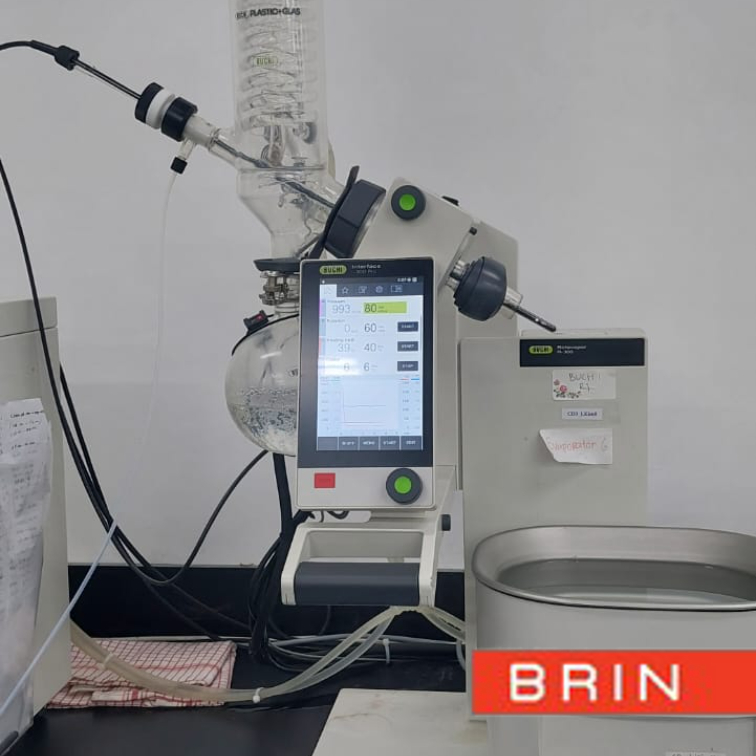
A rotary evaporator is a laboratory instrument used to remove or evaporate solvents from a solution in a controlled manner through a combination of heating, vacuum pressure, and flask rotation. The process enables solvent evaporation at relatively lower temperatures, making it suitable for sample concentration, solvent recovery, and processing of heat-sensitive samples.
ServiceUse of the rotary evaporator for solution concentration, solvent removal, and/or solvent recovery based on the operating conditions specified by the user and within the capacity of the equipment.
Service Specifications- Equipment: Rotary Evaporator
- Function: Evaporation, concentration, and/or recovery of solvents from solutions or extracts
- Sample: Solutions, extracts, extraction fractions, or other materials suitable for rotary evaporation
- Sample Preparation: Prepared by the user; sample preparation is not included in the service
- Operating Parameters: Water bath temperature, vacuum pressure, rotation speed, and processing time are determined based on the sample characteristics and user's requirements
- Solvents: Solvents compatible with the rotary evaporator and meeting applicable laboratory safety requirements
- Service Output: Concentrated sample/extract and/or condensed solvent recovered during the evaporation process
- Operation: Performed by the user according to the applicable SOP and under laboratory staff supervision
- The user must provide information regarding the sample type, sample volume, solvent type and composition, and intended purpose of the rotary evaporation process.
- Samples must be suitable for evaporation and must not contain coarse particles or materials that could cause blockage or damage to the system.
- The sample volume must be within the capacity of the evaporation flask and must not exceed the specified filling limit.
- The user must ensure that the sample and solvent are compatible with the flask, seals, tubing, and other equipment components.
- Flammable, toxic, corrosive, highly volatile, or otherwise hazardous solvents must be declared to laboratory staff and may only be used following appropriate risk assessment and approval.
- The use of organic solvents must comply with the applicable SDS/MSDS, ventilation/fume extraction requirements, and personal protective equipment (PPE) procedures.
- The user must provide the required operating conditions, including water bath temperature, vacuum pressure, and rotation speed, where these have been determined based on the experimental method.
- Vacuum pressure and temperature should be adjusted gradually to minimize the risk of bumping, foaming, overheating, or sample loss during evaporation.
- The evaporation flask must be properly installed and secured before operation.
- Users are not permitted to modify or disassemble the vacuum system, condenser, seals, or other equipment components without authorization from laboratory staff.
- The vacuum system must be checked before use to ensure that there are no leaks that could interfere with the process or create a safety hazard.
- After completion of the process, the user must ensure that the system is in a safe condition before removing the flask or releasing the vacuum.
- The flask, work area, and equipment components that come into contact with the sample must be cleaned after use.
- Users must follow the applicable SOPs, laboratory safety procedures, and equipment operating instructions.
- The user is responsible for the quality, safety, and suitability of the samples and solvents used.
- Samples must be homogeneous or otherwise suitable for rotary evaporation.
- Samples containing significant amounts of solids should be filtered or separated before the evaporation process.
- Solvents must have properties suitable for evaporation and be compatible with the equipment.
- High-boiling-point or difficult-to-evaporate solvents require special consideration regarding the operating temperature and vacuum pressure.
- Solvents that produce hazardous, flammable, or corrosive vapors require special handling in accordance with laboratory safety procedures.
- Users must provide the SDS/MSDS for hazardous solvents or materials when requested by laboratory staff.
The rotary evaporation service may produce:
- Concentrated extracts or solutions
- Samples with reduced or removed solvent content
- Condensed solvent recovered during the evaporation process
- Samples ready for subsequent analysis or processing